Your home’s main sewer line is one of its most important plumbing components, and the one most homeowners rarely think about until something goes wrong. In Metro Atlanta, sewer line problems are particularly common due to the combination of mature tree canopy, aging clay and cast iron pipes, and shifting Georgia clay soil. Learning to recognize the early warning signs of a failing sewer line can help you avoid a full basement sewage backup, which is among the more expensive and unpleasant home repairs.
What Is the Main Sewer Line?
Every drain in your home, every toilet, sink, shower, bathtub, and appliance drain, eventually connects to a single large pipe that exits your home and runs underground to either the municipal sewer main beneath the street or a septic tank on your property. This is your main sewer line, and it is typically 4 to 6 inches in diameter. Because all of your home’s wastewater flows through this single pipe, a blockage or failure in it can affect every plumbing fixture in the house at once.
Warning Sign #1: Multiple Fixtures Draining Slowly or Backing Up Together
If only one fixture is draining slowly, you almost certainly have a localized clog in that fixture’s branch drain. But if two or more fixtures in different parts of your home are backing up at the same time, especially if flushing a toilet causes water to gurgle up in a nearby shower, that is a textbook indicator of a main line blockage somewhere between those fixtures and the street. This is a plumbing emergency that warrants immediate attention before the situation escalates to a sewage backup.
Warning Sign #2: Sewage Odors Inside the Home Without an Obvious Source
A properly functioning sewer line is airtight and sealed. Gases produced by decomposing waste remain inside the sealed pipe system and are safely vented upward through the vent pipes exiting your roof. If you detect a persistent sewage or rotten egg smell inside your home, particularly at floor level or near drains, it means sewer gas is escaping from somewhere in the system. This is commonly caused by a cracked or broken sewer pipe beneath the slab or in the yard.
Warning Sign #3: An Unusually Lush or Wet Patch in the Yard
In Atlanta’s hotter months, a defined patch of grass in your yard that appears noticeably greener, thicker, and more lush than the surrounding lawn is a classic sign of a slow sewer leak beneath it. Sewage is, in a practical sense, a nutrient-rich fertilizer for grass. Combined with the constant moisture of a leaking pipe, a compromised sewer line beneath your yard creates ideal growing conditions directly above the leak point. If this patch also feels soft or spongy underfoot without recent rainfall, that’s a strong additional indicator.
Warning Sign #4: Foundation Cracks or Sinkholes Near the Home
A sewer line that has completely broken underground will continuously saturate the surrounding soil with water and waste. As Georgia’s clay soil becomes saturated, it loses its structural integrity and can begin to sink or shift. This creates voids and soft spots that, over time, can result in visible cracks appearing in your foundation, driveway, or walkways near the area of the break. In serious cases, a sinkhole can develop in the yard directly above a collapsed sewer pipe.
Warning Sign #5: Rodents or Insects Entering from Drains
A cracked or separated sewer pipe underground creates an entry point into the drain system for rats, mice, and cockroaches. These pests can travel through the pipe system and surface through floor drains, particularly in basements and ground-floor bathrooms. A sudden and unexplained rodent or roach infestation, particularly if centered around a bathroom or utility room, can sometimes be traced back to a broken sewer line.
Atlanta’s Main Sewer Risk Factor: Tree Roots
Atlanta is one of the most densely forested major cities in the United States. The aggressive root systems of the oaks, sweetgums, pines, and silver maples that define Atlanta’s iconic tree canopy are constantly expanding underground in search of moisture and nutrients. A sewer line is one of the warmest, most nutrient-rich sources of moisture they can find, and roots, even from trees that appear far from your house, will find even a hairline crack or a joint gap in your sewer pipe and aggressively grow into it.
Root-invaded sewer lines in Dunwoody, Brookhaven, Sandy Springs, and intown Atlanta neighborhoods are extremely common because of the large, decades-old tree populations in those areas. Early root intrusion can often be managed with professional drain cleaning. However, advanced intrusion that has compromised the pipe’s structure requires professional, open-trench excavation and a full sewer line replacement to permanently solve the problem.
How a Sewer Camera Inspection Works
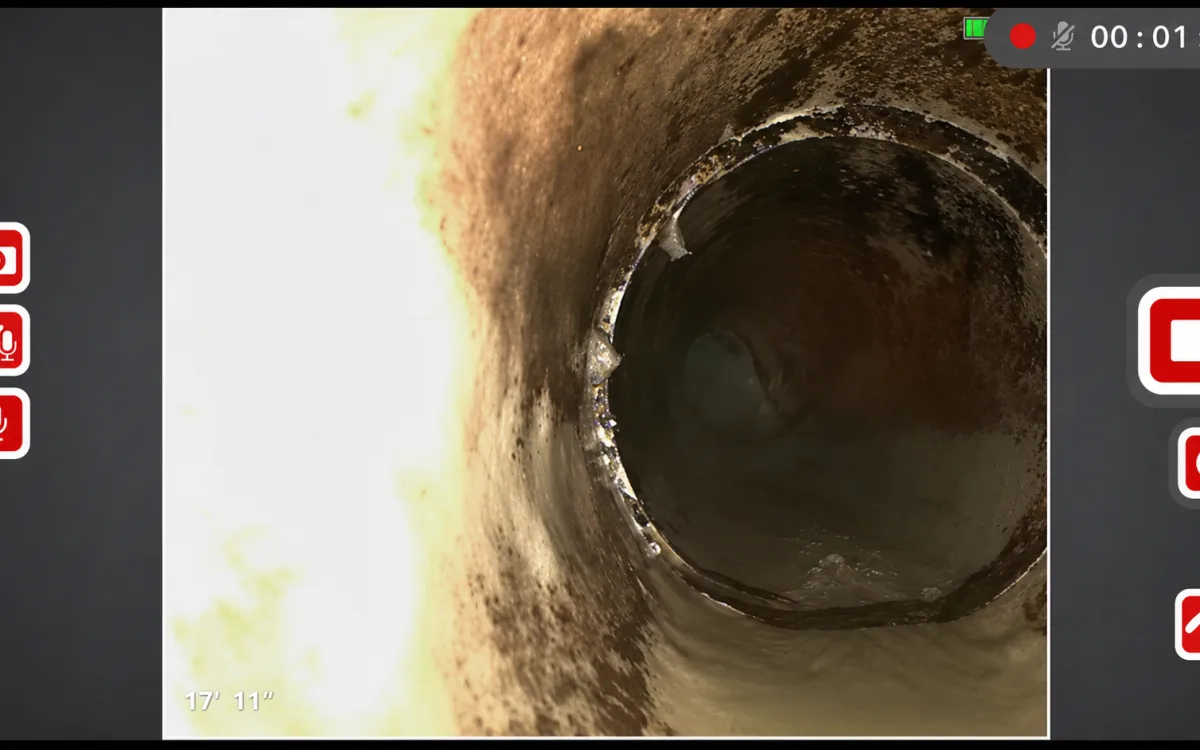
A sewer camera inspection is the definitive diagnostic tool for sewer line problems. A flexible cable equipped with a high-definition waterproof camera is inserted into the cleanout access point on your main sewer line. As it travels the length of the pipe to the street, the camera transmits live footage showing the interior condition of the pipe, any root intrusions, cracks, sags, offset joints, or blockages are immediately visible and can be recorded for documentation.
A sewer camera inspection is recommended before purchasing any older home in Metro Atlanta, particularly in tree-heavy neighborhoods. It is also the first step in diagnosing persistent slow-drain or gurgling issues.
How Sewer Pipe Materials Tend to Age
These are general industry patterns, not a prediction for your house. Actual lifespan depends on soil, installation quality, and tree cover, and only a camera inspection can tell you the condition of your specific line.
- Cast iron: Long-lived in theory, but it rusts and corrodes from the inside, and humid climates like Atlanta are hard on it.
- Clay / terracotta: Brittle and prone to cracking from root intrusion and soil movement. Common under older Atlanta neighborhoods.
- ABS / PVC plastic: The modern standard. Resistant to corrosion and more flexible than older materials.
- Orangeburg (bituminized fiber): A wartime-era compressed wood-fiber pipe with the shortest useful life of the group. Homes built in the 1940s through 1960s may still have Orangeburg lines that are well past it.
Don’t Wait for a Sewage Backup
Ignoring the early warning signs of a failing sewer line can lead to a messier, more expensive repair down the road. If you are experiencing persistent slow drains, unexplained yard odors, or suspect tree root intrusion, you need answers fast. A&G Plumbing provides high-definition sewer camera inspections to help diagnose the problem. If a replacement is necessary, our excavation crews stand behind their work.
Protect your home from a sewer emergency. Call A&G Plumbing at (770) 627-4421 or schedule an inspection online today.