Sewage is backing up into the tub, the yard smells, and the first question is always the same: will the city fix this? Across Metro Atlanta the honest answer is that it depends on who provides your sewer service, and the rules are not what most articles claim. The City of Atlanta, for example, says the entire sewer service lateral is the property owner’s responsibility. Because that lateral runs from the house all the way to the city sewer line, it can include pipe past the property line and under the street. Here is what the local authorities actually say, what to do while it is happening, and how A&G approaches the repair side. If you want to talk it through with a person, call (770) 627-4421.
Sewage backing up right now?
Do these things first, in this order.
- Stop adding water. No flushing, no laundry, no dishwasher, no showers. Every gallon has nowhere to go but back into the house.
- Keep people and pets away from the affected area and out of the water.
- Do not open or remove a cleanout cap that is holding back sewage, and do not stand in pooled wastewater.
- If several neighbors have the same backup at the same time, that suggests a problem in the public system. Report it to your sewer provider using the number on your sewer bill.
- For anything on your side of the system, stop there and call a licensed plumber. A&G answers Monday through Friday, 9 AM to 5 PM, at (770) 627-4421, with same-day visits during business hours when the schedule allows. After hours, leave a message. Urgent calls are scheduled first when we open the next business day. For an active emergency after hours, contact an emergency service or your utility.
The parts of the system, named correctly
Four pieces matter for the who-pays question. The building drain carries wastewater inside your home. The building sewer, usually called the service lateral, is the buried pipe that carries it from your house toward the public system. The connection, sometimes called the tap, is where your lateral meets the public pipe. The public main is the larger pipe, often under the street, that serves the whole neighborhood. The public main belongs to the sewer authority. The open question on every property is where responsibility for the lateral ends, and that answer belongs to your serving authority, not to a rule of thumb.
One rule of thumb deserves a specific warning. Many articles, including an earlier version of this one, say a cleanout near the property line marks where your responsibility ends. A cleanout is an access point for equipment. It is not an ownership boundary, and in Atlanta the city’s own guidance puts the entire lateral on the owner regardless of where the cleanout sits.
First find out who actually serves your address
Your postal city, your city limits, your county, and your sewer provider are four different things, and they often disagree. A Marietta mailing address can be served by Cobb County Water System. The name on your sewer bill is the authority whose rules apply to you. Find that name first, then use that provider’s current guidance. Everything below summarizes what each authority’s own published material said when we checked it, with the date we checked.
What the local authorities say
City of Atlanta
The City of Atlanta says the service lateral connects your building’s sewer to the city sewer line, and that maintenance and repair of the entire sewer service lateral is the property owner’s responsibility. That means the whole run, from the house to the connection with the city main, including any portion under a sidewalk or street. A cleanout near the property line is common in Atlanta, but under the city’s current guidance it is an access point and does not shift any part of the lateral to the city. Problems in the public main itself are the city’s side; report those through 311.
Source: ATL311 knowledge article “What is a sewer service lateral?”, atl311.com, contact 311 or 404-546-0311. Checked on 2026-07-19.
City of Marietta
The City of Marietta’s utility FAQ describes a specific process rather than a simple boundary. The city says the property owner is responsible for removing a blockage in the service line even when the blockage sits within a road right-of-way or a sewer easement. The process starts with your own plumber: if a licensed plumber or contractor you hire cannot restore service, the contractor contacts the Water and Sewer Department at 770-794-5230, and the department may then remove a blockage located in those public areas. The city’s role there is limited to removing the blockage. Restoring the service line and the property stays with your plumber or contractor, and the city says the line must be exposed with personnel present when its staff arrive. Where a pipe failure is suspected within the public right-of-way or easement, the city says the department will repair the line within those areas. If your line needs that first clearing attempt, our drain cleaning team handles it during business hours.
Source: City of Marietta utility FAQ, mariettaga.gov, department contact 770-794-5230. Checked on 2026-07-19.
Cobb County Water System
Cobb County Water System says it operates and maintains the wastewater collection mains, which run from 8 inches up to 72 inches in diameter, and it lists 770-419-6201 as its emergency dispatch number for a sewer backup in a home or street. The county’s site poses the question “Who is responsible for sewer repairs on my property?” but we could not read the full published answer when we checked, so we will not guess at the exact boundary here. Before spending money on that question, call CCWS customer service at 770-419-6200 and ask where the county’s responsibility ends for your specific address.
Source: Cobb County Water System sewer infrastructure maintenance page, cobbcounty.gov. Checked on 2026-07-19.
Rented, shared, and special situations
The utility’s rule is not always the last word on who pays. A lease can assign responsibility between tenant and landlord. Condo and HOA documents can assign shared laterals to the association or to individual owners. Some older streets have laterals shared between neighbors under their own agreements. Homes on septic systems are a different subject entirely. If any of those apply to you, read the documents or ask the association before assuming the answer.
What a camera inspection shows, and what it does not
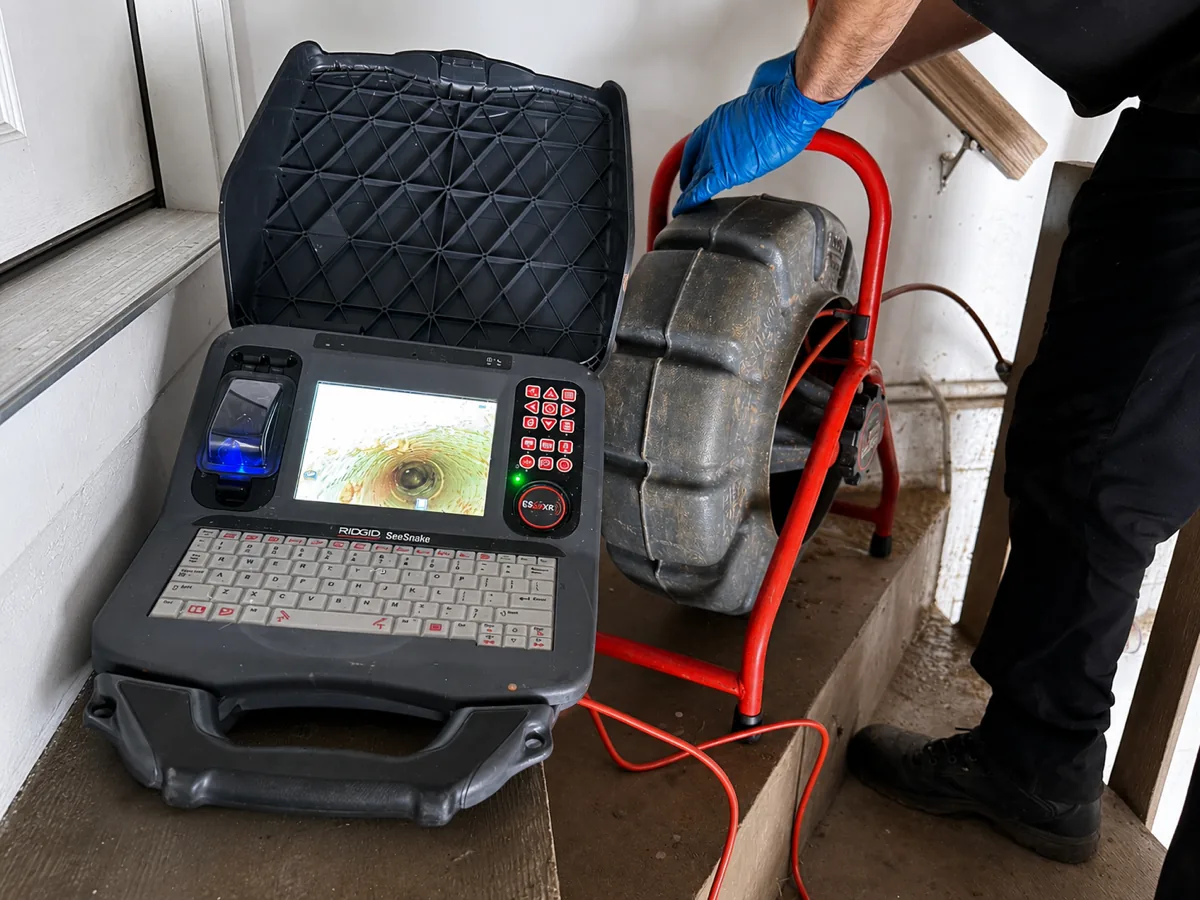
A sewer camera inspection sends a waterproof camera down the line so you can see what is actually in there: roots, cracks, bellies, grease, standing water, or a collapse, along with the measured distance of each problem from the access point. That is diagnostic information, and it is the right first step before anyone digs. What a camera cannot do is decide legal responsibility. Ownership depends on your serving authority’s rules and on where the pipe sits relative to the connection, the property, and any easement. Those are questions for the utility’s records and policies, not for a distance readout. What the inspection gives you is honest documentation, video and findings you can share with your utility or your insurer, each of which follows its own process and makes its own decision.
How A&G handles the repair side
When the problem is on your side of the system, our main sewer line service covers repair and replacement. We do not quote sewer work from internet price ranges, because depth, length, pipe material, access, and how much of the line is affected make every job different. Our process is simple: we inspect the line first, then you get a written price. You approve the price before we start. If we uncover a hidden problem, we stop and get your approval before anything that changes the price. If the inspection turns up a separate issue, we price it separately and you decide what happens next. Request service or call (770) 627-4421.
Frequently asked questions
Is the city ever responsible for my sewer line in Georgia?
Every authority we checked treats its public main as its own responsibility. For the lateral, it depends on your serving authority. The City of Atlanta says the entire lateral is the property owner’s. Marietta describes a process where the owner clears blockages first and the city steps in only in specific situations. Ask the authority named on your sewer bill for your address.
Does my cleanout mark where my responsibility ends?
No. A cleanout is an access point for cleaning and inspection equipment. Some authorities treat certain cleanouts differently, so ask your serving authority rather than assuming a boundary from what is visible in the yard.
Who pays if tree roots clog the line under the street?
It depends on the serving authority. In the City of Atlanta, the city’s guidance puts the entire lateral on the owner, and it states no exception for sections that run under public ground. In Marietta, the owner is responsible for clearing a blockage even in the right-of-way, with city assistance only under the conditions in its FAQ. Confirm with your own provider before assuming either answer.
Does homeowners insurance cover sewer line repair?
Policies and endorsements differ, so check directly with your insurer or agent about your own coverage. A&G can share the inspection video and written findings with you, and you can pass those along. We cannot determine coverage or liability.
How do I know if the backup is my problem or the city’s?
There are clues, but clues are not proof. Several homes backing up at the same time suggests the public main. One home with slow drains that got worse over weeks suggests the private side. The reliable path is to report a suspected public problem to your sewer provider and have a licensed plumber inspect the private side, then compare what each finds.
Can A&G handle the repair once the problem is found?
If it is on your side of the system, yes. We inspect the line, walk you through what the camera shows, and give you a written price you approve before work starts. We are open Monday through Friday, 9 AM to 5 PM, with same-day visits during business hours when the schedule allows. Call (770) 627-4421.
City and county guidance summarized above was checked on 2026-07-19. Utility policies change, so confirm the current rule with your serving authority before making decisions.