A toilet that runs constantly, or a toilet running on and off through the day, is one of the most wasteful plumbing problems a home can have. The EPA estimates a running toilet can waste up to 200 gallons of water a day, and all of it shows up on your Cobb County or Fulton County water bill. The good news is that most running toilet causes come down to a small, inexpensive part inside the tank. This article walks through the four most common reasons for a toilet running and how to spot each one. It is general information, not professional advice, so call a licensed plumber if you are unsure.
How a toilet actually works
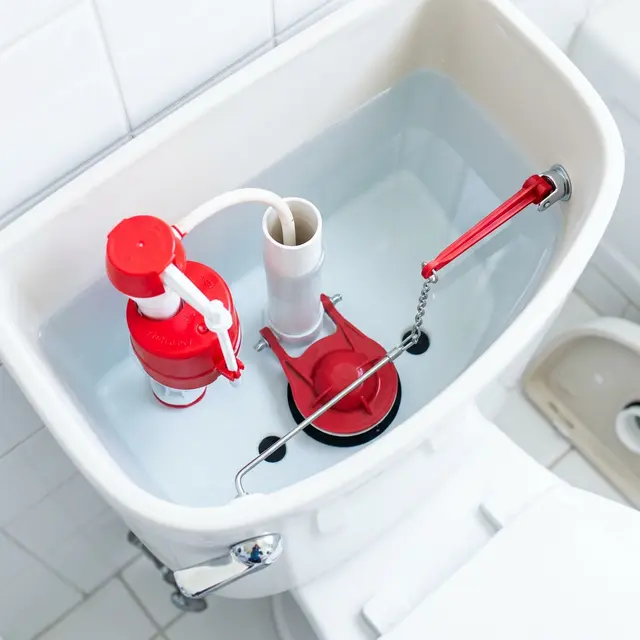
Before you can figure out why your toilet is running, it helps to understand the simple mechanism inside the tank. Every gravity-flush toilet operates on the same basic principle:
- You flush. The flush handle raises a flapper (a rubber or plastic seal at the bottom of the tank) via a chain.
- With the flapper raised, the stored water rushes down through the flush valve opening into the bowl, creating the flush.
- As the tank empties, a float (either a ball float on an arm or a cup float on the fill valve) drops with the water level.
- The dropping float opens the fill valve, which refills the tank with fresh water.
- As the water rises, the float rises with it. When it reaches the set level, it signals the fill valve to shut off, and the cycle is complete.
A running toilet almost always comes down to one of four things: the flapper is not sealing, the float is set too high, the fill valve is failing, or the flush valve seat is damaged.
Cause 1: a worn or warped flapper
The flapper is the most common cause of a running toilet by far. Flappers are made of rubber, and rubber degrades over time in chlorinated municipal water. Many plumbers recommend replacing toilet flappers every few years, whether or not the toilet is running.
A simple test: lift the tank lid and press down firmly on the flapper with your finger while the toilet is running. If the running sound stops immediately, the flapper is the culprit and has a bad seal. Replacement flappers cost about $5 at any hardware store and take less than five minutes to swap out.
Cause 2: the float is set too high
If the float is adjusted to a level that causes water to fill above the open top of the overflow tube (the tall open tube in the center of the tank), water will constantly drain down that tube into the bowl, creating a continuous running sound. You’ll know this is the issue if you look in the tank and see water trickling down into the overflow tube.
The fix is adjusting the float height. On older ball-float systems (with a ball on a metal arm), you can bend the arm slightly downward. On modern cup-float systems, there’s an adjustment screw or clip on the fill valve stem. The water level in the tank should sit about an inch below the top of the overflow tube.
Cause 3: a failing fill valve
Fill valves wear out over time. When they do, they may allow a slow, continuous trickle of water into the tank even when the float is at the correct height. You can confirm this by putting a few drops of food coloring in the tank and waiting 15 to 20 minutes without flushing. If colored water appears in the bowl without any flushing, water is getting through somewhere, usually a bad flapper or fill valve. Fill valves are inexpensive ($10 to $20) and relatively straightforward to replace.
Cause 4: a cracked flush valve seat
The flush valve seat is the smooth opening at the bottom of the tank that the flapper presses against to seal. If the seat develops a crack, warp, or mineral deposit along its edge, the flapper cannot form a complete seal no matter how new it is. Running your finger around the rim of the flush valve seat and feeling for roughness or deposits can diagnose this. Mineral deposits can sometimes be sanded smooth; a cracked seat requires replacing the entire flush valve assembly.
Why does my toilet randomly run? The ghost flush
Has your toilet ever started running on its own with nobody in the room? Plumbers call that a ghost flush or phantom flush, and it is the usual answer when a homeowner asks why their toilet randomly runs. A slow flapper leak gradually lowers the tank water level until it drops below the trip point of the fill valve, which kicks on briefly to refill the tank. The cycle repeats, so you hear the toilet running on and off every ten minutes or every few hours. It is almost always a flapper problem, and it is very common in older Marietta and Kennesaw homes.
What a running toilet costs you
A flapper leak runs day and night whether anyone is home or not, and metro water rates make that waste add up quickly. Left alone for a few billing cycles, a worn $5 part can waste more water than your family uses on purpose. Checking the flapper, the float, and the fill valve usually takes a few minutes with the tank lid off.
If the running sound will not stop, we can help. Call A&G Plumbing and Drain at (770) 627-4421 during business hours or request toilet repair online. You approve the price before we start.