
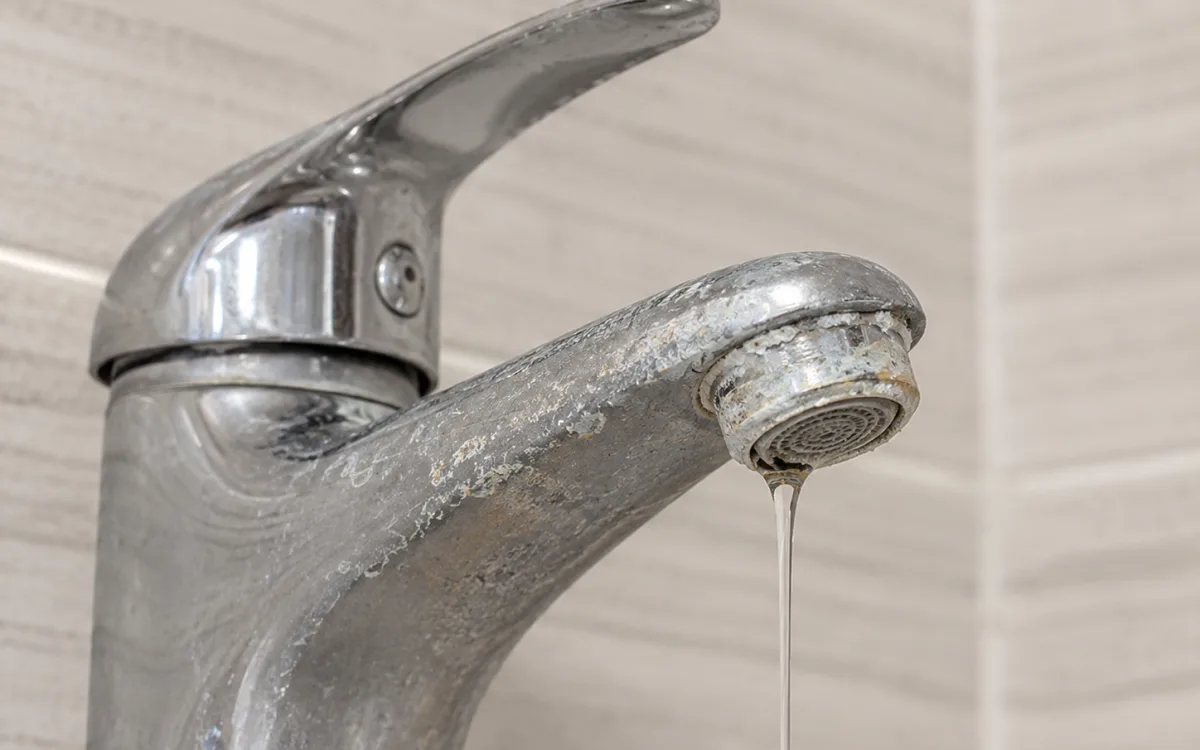
You’ve probably heard the term “hard water” before, but you might not know exactly what it means or whether Atlanta’s water qualifies. The short answer, by the numbers the local utilities publish, is softer than most people assume. Cobb’s supplier reports averages around 32 to 35 mg/L, which is soft, and Cherokee County reports 16 mg/L, which is very soft. This guide explains what hardness means and what mineral buildup can still do over time. Understanding Atlanta’s water quality helps you make smarter decisions about your home’s plumbing maintenance.
What Is Hard Water?
Water hardness is simply a measure of the dissolved mineral content, primarily calcium and magnesium, in your water supply. The more of these minerals, the “harder” the water. Hardness is measured in grains per gallon (GPG) or milligrams per liter (mg/L, same as parts per million or PPM):
- Soft: 0 to 1 GPG (0 to 17 mg/L)
- Slightly Hard: 1 to 3.5 GPG (17 to 60 mg/L)
- Moderately Hard: 3.5 to 7 GPG (60 to 120 mg/L)
- Hard: 7 to 10.5 GPG (120 to 180 mg/L)
- Very Hard: Over 10.5 GPG (180+ mg/L)
Does Atlanta have hard water?
Hardness varies by water system, so the honest answer starts with your own utility’s annual water quality report. Here is what the utilities themselves publish:
- Cobb County-Marietta Water Authority (treats the water for Marietta, Kennesaw, Smyrna, and most of Cobb): average hardness of 31.7 to 35.1 mg/L at its two plants, which is soft (CCMWA annual water quality data, checked July 2026)
- Cherokee County Water and Sewerage Authority (Woodstock, Canton): 16 mg/L, which is very soft (CCWSA, checked July 2026)
Where the local utilities publish hardness numbers, they come in soft to very soft, and even soft water can leave light deposits in a water heater over many years.
Homeowners often ask the broader question too: does Georgia have hard water? For most of the state, the answer mirrors Metro Atlanta. Hardness varies from one water system to the next, and much of Georgia falls somewhere in the slightly hard to moderately hard range, so the maintenance habits covered below apply well beyond the metro area.
What Hard Water Does to Plumbing in Places That Have It
Metro Atlanta’s utility water does not reach the hard range, so the problems below are what plumbers see in genuinely hard-water regions, and sometimes in local homes on private wells, where hardness depends on the rock the well draws through. They are worth understanding for two reasons: you will know what to watch for if you own property somewhere with harder water, and you will know which problems you can mostly cross off your list here.
Scale Buildup Inside Pipes
When hard water is heated, as it is constantly inside a water heater, the calcium and magnesium it carries deposit out as a white, chalky layer of scale on any surface it contacts. In a genuinely hard-water area, that scale accumulates year after year, narrowing a pipe’s effective interior diameter, and it is a common reason water heaters there lose efficiency and fail early. On our soft utility water the same chemistry runs far more slowly: expect a light layer of sediment in a water heater tank after years of service, which is one reason an annual flush is still worth doing, not choked pipes.
Shortened Appliance Lifespan
In hard-water conditions, dishwashers, washing machines, coffee makers, ice makers, and water heaters all take a significant hit. Heating elements become coated in mineral scale, forcing them to work harder to achieve the same output, and units running on hard water can lose efficiency and fail earlier than the same units running on soft water. That comparison is good news locally: on soft water, your appliances get the easier half of the deal.
Spotting and Staining on Fixtures
Any water leaves faint spots when droplets dry on glass or chrome, because evaporation concentrates whatever minerals are present, so light spotting is normal even on soft water and wipes away easily. The heavy, crusty buildup that cakes a showerhead and chokes its flow is a hard-water symptom, and with the soft numbers our utilities publish it should be uncommon here. If a showerhead has slowed anyway, a vinegar soak is still the right first move, and if flow does not come back, the restriction usually sits past the fixture and is worth a closer look.
Soap and Shampoo Efficiency
Calcium and magnesium ions in hard water bind to soap molecules and stop them from lathering, which makes lather one of the oldest home tests for hardness. It also means soft water shows off: soap, shampoo, dish soap, and laundry detergent all lather easily and rinse clean in most metro Atlanta homes, and you generally need less product, not more. If soap lathers well but you still feel a film on your skin, the water’s hardness is probably not the culprit.
The Difference Between a Water Softener and a Water Filter
These two products are often confused but serve entirely different purposes:
- Water Softener: Uses a process called ion exchange to swap the calcium and magnesium ions for sodium ions, removing the hardness minerals entirely. Softened water still contains the same overall amount of dissolved solids, but they’re now sodium-based and do not form scale deposits. Softeners require periodic regeneration with salt pellets.
- Water Filter: Removes contaminants like chlorine, sediment, chloramines, volatile organic compounds, and some heavy metals. A standard carbon block filter does not remove hardness minerals. Reverse osmosis filters (under-sink units) are the exception, they reduce hardness but are typically used for drinking water only, not whole-house water treatment.
Simple Maintenance for Metro Atlanta Water
- Flush your water heater tank annually to remove accumulated sediment.
- Soak showerheads and faucet aerators in white vinegar quarterly.
- Use citric acid-based dishwasher rinse aid to prevent spotting on dishes.
- Clean toilet bowl mineral rings with a pumice stone or citric acid cleaner.
- Skip the water softener unless the numbers say otherwise. On the soft readings our utilities publish, a softener has little scale to remove. The exceptions are a private well, or a utility report that puts your hardness in the hard range on the scale above, at 120 mg/L or more. Check your own annual water quality report before spending the money.